
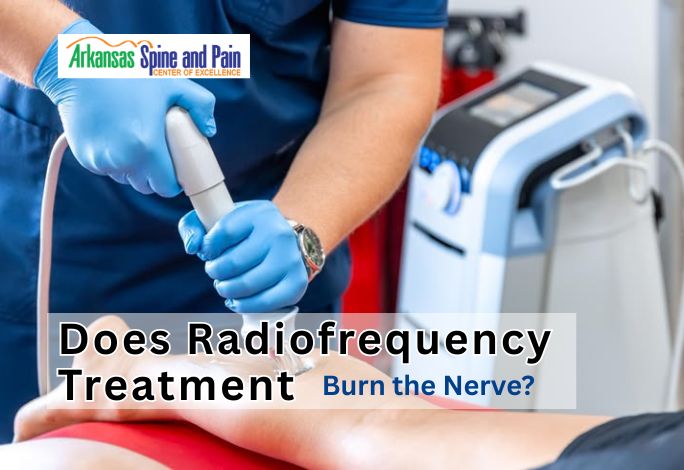
Radiofrequency treatment is a commonly recommended option for people dealing with chronic back pain who want relief without surgery. Despite its growing use, many patients feel uneasy about the term itself and ask an understandable question: does radiofrequency treatment actually burn the nerve?
The short answer is not in the way most people imagine, but the full explanation is important. Understanding what radiofrequency treatment does to the nerve, how controlled the process is, and why it is considered safe can help reduce fear and set realistic expectations before treatment.
What Is Radiofrequency Treatment for Back Pain?
Radiofrequency treatment, also called radiofrequency nerve ablation (RFA), is a minimally invasive procedure designed to reduce chronic back pain by disrupting pain signals. It is most commonly used for pain coming from the facet joints of the spine, which can become irritated due to arthritis, degeneration, or repetitive strain.
The procedure targets sensory nerves only, meaning nerves that carry pain signals, not nerves that control muscle movement or strength. This distinction is critical for safety and function.
Does Radiofrequency Treatment Actually “Burn” the Nerve?
Technically, radiofrequency treatment uses heat, but the word “burn” can be misleading. The nerve is not burned in an uncontrolled or destructive way. Instead, controlled thermal energy is applied to a very specific portion of the nerve to interrupt its ability to transmit pain signals.
The temperature used is carefully regulated and delivered for a precise amount of time. The goal is to disrupt nerve signaling, not to destroy surrounding tissue or damage the spine. Think of it as temporarily disabling the nerve’s ability to communicate pain rather than burning it away.
What Happens to the Nerve After RFA?
After radiofrequency treatment, the targeted nerve loses its ability to transmit pain signals effectively. Over time, the nerve can regenerate. This is why radiofrequency treatment is not considered permanent.
Importantly, the nerve is not removed and does not disappear. It simply stops sending pain signals for an extended period. As the nerve slowly heals and regrows, pain may gradually return, often months later.
This natural regeneration process is also why radiofrequency treatment can be safely repeated if it provides good relief initially.
Why Heat Is Used in Radiofrequency Treatment
Heat is used because it allows for precise control. Radiofrequency energy creates a predictable lesion at the tip of the treatment needle. This controlled lesion interrupts the nerve at exactly the point needed without affecting nearby muscles, spinal cord, or major nerves.
Because the treatment is done under imaging guidance, doctors can position the needle accurately and avoid structures that should not be affected.
How Doctors Make Sure the Right Nerve Is Treated
Before radiofrequency treatment is ever performed, patients usually undergo diagnostic nerve blocks. These are temporary injections that numb the suspected pain-causing nerve.
If the nerve block significantly reduces pain, it confirms that the correct nerve has been identified. Only after this confirmation is radiofrequency treatment considered. This step is essential to both effectiveness and safety.
Is Radiofrequency Treatment Safe?
When performed by experienced specialists, radiofrequency treatment is considered very safe. Because it is minimally invasive, it avoids many of the risks associated with surgery.
Side effects are usually mild and temporary. Some patients experience soreness, stiffness, or swelling near the treatment site for a few days. Serious complications are rare because the treatment targets sensory nerves only and avoids motor nerves.
Will Radiofrequency Treatment Affect Movement or Strength?
No. Radiofrequency treatment does not affect muscle strength or movement. The nerves targeted are responsible for transmitting pain, not controlling muscles.
Patients can walk, move, and function normally after the procedure. In fact, many patients move more comfortably once pain signals are reduced.
How Long Does the “Burned” Effect Last?
Although the nerve is disrupted using heat, the effect is temporary. Pain relief typically lasts 6 to 18 months, depending on the individual and the underlying condition.
If you want a deeper explanation of duration and expectations, this topic is explored in detail in the related guide:
Is Radiofrequency Nerve Ablation Permanent for Back Pain?
Understanding that RFA offers long-term—but not permanent—relief helps patients plan realistically and avoid disappointment.
Why Some Patients Feel Nervous About the Term “Ablation”
The word “ablation” sounds aggressive, but in pain management, it refers to controlled interruption, not destruction. Medical ablation techniques are designed to be precise, predictable, and reversible over time.
Education is key. Once patients understand that the nerve is carefully targeted and allowed to regenerate naturally, fear often decreases significantly.
Who Is a Good Candidate for Radiofrequency Treatment?
Radiofrequency treatment works best for patients with chronic back pain coming from facet joints who have responded positively to diagnostic nerve blocks. It is not appropriate for all types of back pain, such as pain caused by large disc herniations or spinal instability.
Proper evaluation ensures that radiofrequency treatment is used only when it is likely to be effective.
Care at Arkansas Spine and Pain Center
At Arkansas Spine and Pain, radiofrequency treatment is approached with precision and patient education at the forefront. Every patient undergoes careful diagnostic testing to confirm the correct nerve source before treatment is recommended. The focus is on safe, evidence-based care that reduces pain while preserving movement, strength, and long-term spinal health.
Frequently Asked Questions
1. Does radiofrequency treatment permanently burn the nerve?
No, the nerve is disrupted temporarily and can regenerate over time.
2. Is the heat used during RFA dangerous?
No, the heat is carefully controlled and localized to the targeted nerve only.
3. Can RFA damage surrounding tissues?
When performed correctly, surrounding tissues are protected using imaging guidance.
4. Will I feel the nerve being burned?
No, local anesthetic is used to keep the procedure comfortable.
5. How long does pain relief usually last?
Most patients experience relief for 6 to 18 months.
6. Can the procedure be repeated?
Yes, RFA can be safely repeated if pain returns and prior treatment was effective.
7. Does RFA weaken the spine?
No, it does not affect spinal stability or structure.
8. Is radiofrequency treatment safer than surgery?
Yes, it is significantly less invasive and carries fewer risks.
9. Will pain return worse after the nerve heals?
Most patients report similar or less intense pain if it returns.
10. How do doctors know if RFA will work for me?
Diagnostic nerve blocks help confirm whether you are a good candidate.
Final Thoughts
Radiofrequency treatment does not “burn” the nerve in a destructive or dangerous way. Instead, it uses controlled heat to temporarily interrupt pain signals while allowing the nerve to regenerate naturally over time. For many patients with chronic back pain, this approach offers long-lasting relief without surgery, preserves movement and strength, and provides a valuable window for improving overall spinal health.