
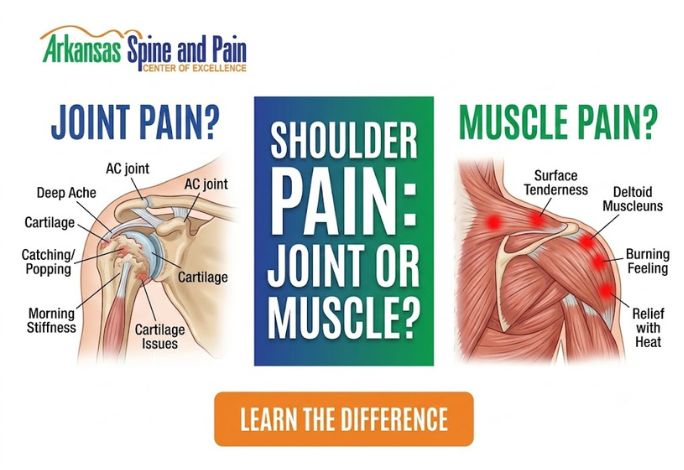
Determining whether an upper extremity ache originates within the skeletal joint socket or stems from the surrounding muscular tissue is one of the most vital distinctions in interventional orthopedics. Because the shoulder complex relies on an intricate balance of dynamic muscle stabilizers and static joint structures, a problem in one area almost always affects the other.
However, joint-based pain and muscle-based pain require fundamentally different treatment pathways. Understanding where your discomfort starts helps you seek the correct medical evaluation and avoids wasted time on ineffective therapies.
Key Differences: Joint Pain vs. Muscle Pain
While both types of discomfort limit daily movement, their underlying mechanisms, physical location, and daily behavior patterns diverge significantly.
Signs Your Pain Is Coming From the Joint
Joint-based issues usually stem from cartilage degeneration, capsular tightening, or deep structural impingement within the glenohumeral or acromioclavicular (AC) joints.
- Deep, Unreachable Ache: You feel a deep discomfort inside the arm bone socket that you cannot massage or press on directly with your fingers.
- Mechanical Symptoms: Reaching overhead or behind your back produces a distinct popping, grinding, catching, or sudden physical “block.”
- Persistent Stiffness: The joint feels locked or rigid, particularly in the morning, requiring significant time to loosen up.
Signs Your Pain Is Coming From the Muscle
Muscular discomfort typically involves strains, trigger points, or fatigue in large muscle groups like the deltoid, trapezius, or rhomboids.
- Surface Tenderness: Pain can be pinpointed by pressing firmly on the tissue, often revealing tight “knots” or hyper-sensitive trigger points.
- Burning or Throbbing Sensation: Muscle soreness frequently presents as a warm, achy, or burning feeling following heavy exertion or prolonged poor posture.
- Relief with Movement and Heat: Gentle stretching, massage, and warm showers usually provide immediate, temporary relief by increasing blood circulation to the tight fibers.
When Muscles Overcompensate for Joint Damage
In many chronic cases, shoulder pain involves both structures simultaneously—a phenomenon known as secondary compensation.
When deep structural damage occurs—such as advanced cartilage wear or a subacromial spur—the body instinctively attempts to guard the injured area. The surrounding muscles, including the upper trapezius and levator scapulae, contract continuously to immobilize the bone socket. Over time, these overworked muscles develop severe trigger points and fatigue. Patients often seek care believing they have a simple neck or muscle strain, when in reality, an underlying joint issue is forcing those muscles into overdrive.
Clinical Diagnosis and Targeted Non-Surgical Care
Accurately differentiating between joint and muscular sources requires a detailed physical exam, motion testing, and diagnostic imaging.
Treating persistent Upper Body Pain effectively relies on pinpointing the true origin of your functional limits. If a physical evaluation reveals that deep joint degeneration or chronic capsular inflammation is driving your discomfort, interventional specialists can introduce targeted, image-guided procedures to calm the area directly.
For structural joint issues, non-surgical clinical options can break the cycle of chronic pain:
- Targeted Anti-Inflammatory Injections: Using fluoroscopy or ultrasound guidance, specialists deliver precise medications via Peripheral Joint Injections to reduce friction and swelling within irritated bursae or tendon sheaths.
- Deep Capsule Interventions: When cartilage loss or severe osteoarthritis within the main socket is present, an Intracapsular (Glenoid) Injection delivers therapeutic relief deep inside the joint space, restoring smooth surface movement.
Expert Joint Evaluation in Central Arkansas
If you are constantly trying to rub out a deep ache while sitting at your desk or finding it difficult to carry groceries along West Markham Street, getting an accurate anatomical diagnosis is essential. Masking deep joint friction with temporary muscle rubs can allow underlying cartilage issues to advance untreated.
At Arkansas Spine And Pain, our medical team specializes in comprehensive non-surgical diagnostics designed to identify the exact source of your pain. Scheduling a consultation with an experienced Doctor of Joint Pain in Arkansas gives you access to advanced imaging and individualized interventional strategies to help you move comfortably again.
Frequently Asked Questions
Can a muscle strain cause catching or clicking in the shoulder?
No. Catching, popping, or locking during movement indicates a mechanical issue inside the joint, such as a labral tear, bone spur, or loose cartilage fragment, rather than a simple muscle strain.
Why does my neck hurt when I have a shoulder joint issue?
When your shoulder joint is inflamed or restricted, your body compensates by overusing the neck and upper back muscles to lift your arm. This constant overcompensation leads to muscle tension and secondary neck pain.
How do doctors test whether pain is in the joint or the muscle?
Physicians perform selective range-of-motion tests and localized pressure exams. If moving your arm passively while your muscles are completely relaxed still causes sharp pain, the issue is almost certainly within the joint capsule.
Will an X-ray show if my pain is coming from a muscle?
Standard X-rays only visualize bones and joint spacing; they do not show muscle tissue. However, an X-ray can confirm or rule out joint arthritis, bone spurs, and space narrowing, helping isolate the cause by process of elimination.
Can physical therapy fix both joint and muscle shoulder pain?
Yes. Physical therapy strengthens weak stabilizing muscles and stretches tight joint capsules. However, if deep joint inflammation is severe, an image-guided injection may be needed first to reduce pain enough to participate in exercises.
Is heat or ice better for joint pain versus muscle pain?
Ice is generally best for deep joint pain and acute inflammation because it constricts blood vessels and numbs deep pain signals. Heat is usually better for muscle tightness because it relaxes tense muscle fibers and increases blood flow.
Can a torn rotator cuff feel like a muscle strain at first?
Yes. Early rotator cuff tendinitis or small micro-tears can initially feel like routine muscle soreness after activity. However, if the ache persists for weeks and causes noticeable weakness when lifting objects, it is likely a tendon tear.
What is a trigger point injection, and does it help joint pain?
Trigger point injections target hyper-irritable muscle knots to force them to relax. While highly effective for primary muscle pain, they will only provide temporary relief if an untreated joint condition continues to irritate those muscles.
How long should I wait before seeing a specialist for shoulder ache?
You should consult a specialist if your pain lasts longer than two to three weeks, restricts your ability to lift your arm, disrupts your sleep, or fails to improve with basic rest and over-the-counter anti-inflammatories.
Can joint pain cause weakness in my entire arm?
Yes. Severe joint inflammation can trigger a neurological phenomenon called reflex inhibition, where your brain automatically stops muscle activation around a painful joint to protect it from further damage.