
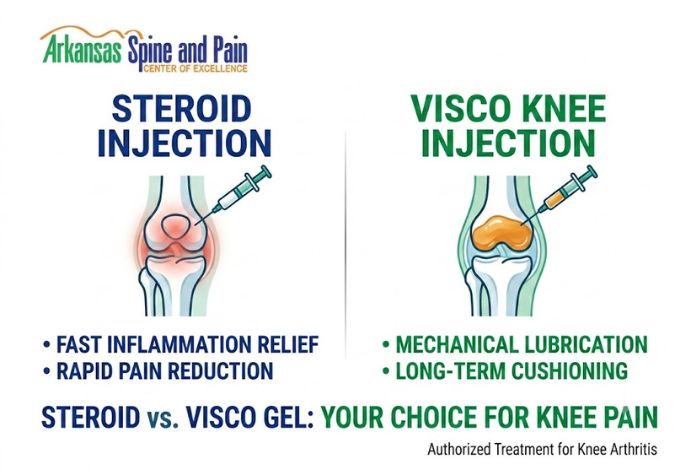
Persistent knee discomfort can profoundly disrupt your daily routine, making simple activities like walking through the professional districts of downtown Little Rock or enjoying a weekend outing near the Arkansas River feel like an uphill battle. When standard oral anti-inflammatory medications and physical therapy fail to provide adequate relief, interventional orthopedic treatments offer a highly effective next step.
Among the most common non-surgical options available are corticosteroid therapies and viscosupplementation. While both treatments are designed to target joint pain directly, they utilize entirely different biological mechanisms, offer distinct timelines for relief, and cater to different stages of joint degeneration. Understanding these differences allows patients to make informed choices alongside their clinical care team.
Corticosteroid Injections: Rapid Control of Acute Inflammation
Corticosteroids, commonly referred to as cortisone shots, are powerful anti-inflammatory medications designed to deliver fast, highly localized pain relief. They do not repair physical damage within the joint, but they excel at breaking the cycle of severe, debilitating pain.
How Steroids Work in the Joint
When a joint suffers from severe osteoarthritis or injury, the synovium the lining of the joint capsule becomes intensely inflamed. This inflammation produces excess fluid, causing stiffness, warmth, and throbbing pain. A steroid Joint Injection in Arkansas delivers a concentrated dose of medication directly to the source of this distress. By rapidly suppressing the immune system’s inflammatory response, it reduces swelling and numbs localized nerve pain signals within a matter of days.
Timeline, Longevity, and Safety Constraints
The primary advantage of a corticosteroid treatment is its speed. Many patients report a dramatic drop in pain within forty-eight to seventy-two hours. This relief typically lasts anywhere from a few weeks to several months.
However, steroids carry strict long-term limitations. Because repetitive exposure to high doses of cortisone can gradually weaken tendons and accelerate the breakdown of surrounding articular cartilage, specialists typically limit these sessions to three or four times per year. They are best utilized as a short-term intervention to calm an acute flare-up, often providing a pain-free window that allows patients to engage comfortably in physical rehabilitation.
Viscosupplementation: Restoring Mechanical Lubrication
Viscosupplementation, frequently called visco shots or hyaluronic acid gel injections, takes a completely mechanical approach to joint care. Rather than down-regulating the immune system, this therapy aims to restore the knee’s natural cushioning environment.
The Science of Hyaluronic Acid Gel
A healthy knee joint naturally contains a thick, slippery substance known as synovial fluid, which is highly rich in hyaluronic acid. This fluid acts as a natural shock absorber and lubricant, allowing the cartilage-covered surfaces of the bones to glide smoothly over one another without friction.
As osteoarthritis progresses, this fluid thins out and loses its protective elasticity, leading to painful bone-on-bone grinding. Visco injections introduce a thick, medical-grade hyaluronic acid gel directly into the joint space to replenish this lost lubrication.
Expectation of Results and Treatment Schedules
Unlike the rapid response seen with steroids, viscosupplementation requires patience. The gel does not provide instant pain relief; instead, it works gradually over several weeks to improve joint mechanics and lower friction. Patients usually notice a gradual reduction in grinding and stiffness, with maximum benefits peaking around four to eight weeks post-treatment.
The resulting relief can be exceptionally long-lasting, frequently keeping pain at bay for six months or more. Furthermore, because hyaluronic acid does not degrade joint tissue or cartilage over time, these series can be safely repeated every six months to manage chronic conditions over the long haul.
Choosing the Right Option for Your Knee Care Strategy
Selecting between these two interventional pathways depends on the current state of your joint and your immediate functional goals.
If your knee is highly swollen, warm to the touch, and severely painful, a cortisone treatment is often chosen first to aggressively knock down the acute inflammation. Once the swelling is controlled, or if your primary complaint is a chronic, dry, mechanical grinding during activity, viscosupplementation may be recommended as a superior long-term management strategy.
A comprehensive approach to knee pain treatment in Arkansas combines specialized diagnostics, customized physical therapy, and targeted interventional therapies. Experienced clinicians use high-resolution ultrasound guidance to ensure that whichever fluid is chosen is delivered with absolute precision into the joint capsule, avoiding sensitive surrounding tissues.
If you are a resident navigating daily pain while traveling through local neighborhoods near West Markham Street or commuting from nearby Benton or Jacksonville, seeking an expert clinical opinion is essential. Consulting with the Best knee pain doctor in Little Rock AR provides the deep medical diagnostic clarity needed to identify the precise cause of your joint friction and build a safe, personalized injection schedule.
Frequently Asked Questions
Can I receive a steroid and a visco shot at the same time?
In certain clinical situations, a physician may administer a steroid shot alongside a visco injection. The steroid provides immediate relief from severe inflammation, while the visco gel establishes long-term lubrication as the steroid wears off.
Is viscosupplementation covered by standard insurance?
Most major commercial insurance providers and Medicare offer coverage for hyaluronic acid injections, particularly for patients with documented knee osteoarthritis who have not found adequate relief from basic conservative care.
How quickly does a cortisone shot begin to relieve knee pain?
Most individuals notice a significant reduction in joint swelling, localized warmth, and sharp pain within two to three days following the procedure, though full effects can sometimes take up to a week.
Does viscosupplementation help repair torn knee cartilage?
No. Hyaluronic acid gel does not regenerate or repair structurally torn cartilage or a damaged meniscus. It functions strictly as a mechanical lubricant and shock absorber to reduce friction in arthritic joints.
What are the main side effects of a steroid knee injection?
Common side effects include a temporary increase in localized soreness for the first twenty-four hours, skin lightening around the injection site, and a temporary elevation in blood sugar levels for diabetic patients.
How many visco injections are required for a full treatment cycle?
Depending on the specific brand of hyaluronic acid gel utilized by your specialist, a treatment cycle may consist of a single, highly concentrated dose or a series of three weekly injections.
Why is there a strict annual limit on cortisone shots?
Limiting cortisone to three or four times per year is necessary because frequent usage can weaken surrounding tendons, damage localized ligaments, and accelerate the structural breakdown of the remaining articular cartilage.
What should I avoid immediately after a knee injection?
Patients are generally advised to avoid strenuous, high-impact activities, heavy lifting, or prolonged standing for the first forty-eight hours following either treatment to allow the medication to settle.
Can visco injections be used for joints other than the knee?
While FDA-approved primarily for knee osteoarthritis, specialists occasionally utilize viscosupplementation off-label to manage severe mechanical grinding and pain in other major joints, such as the hip or shoulder.
What is the next step if neither injection provides lasting relief?
If both steroid and visco treatments fail to manage your discomfort, providers at Arkansas Spine And Pain can explore alternative minimally invasive solutions, such as radiofrequency ablation of the genicular nerves or regenerative options.