
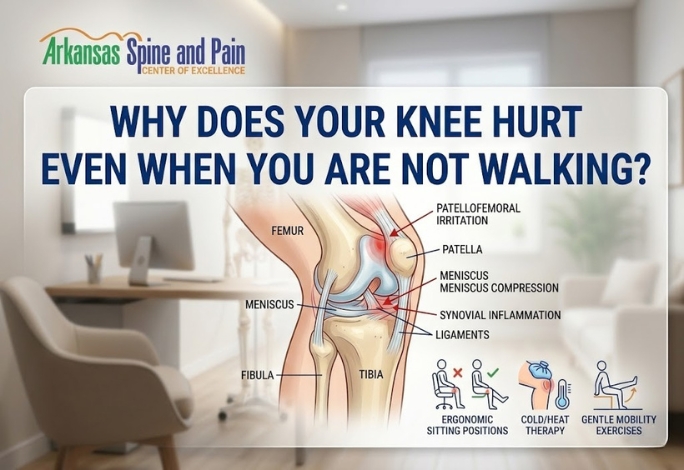
Waking up with a throbbing ache in your knee or feeling a sharp sting while sitting at your desk can be more frustrating than pain that occurs during exercise. When your knee hurts without the “excuse” of movement, it often signals that the underlying issue has moved past simple overexertion. At Arkansas Spine And Pain, we frequently consult with patients who are confused by this sedentary discomfort, which can range from a dull, heavy pressure to a burning sensation that prevents sleep.
Understanding why your knee joint reacts this way while at rest requires a look at the internal mechanics of the joint. The knee is a complex intersection of bone, cartilage, ligaments, and fluid. When these components are inflamed or damaged, the absence of movement doesn’t necessarily mean the absence of stress. In fact, certain conditions cause fluid to build up or nerves to become compressed specifically when the joint remains in a static position for too long.
Common Causes of Knee Pain at Rest
One of the most frequent culprits for resting knee pain is inflammation within the synovium, the lining of the joint capsule. When you are active, joint fluid circulates; however, when you are still, inflammatory chemicals can settle, causing the joint to feel “full” or stiff. This is why many people experience a significant increase in discomfort late at night or first thing in the morning.
Osteoarthritis is another leading factor. As the protective cartilage wears thin, the bones may slightly shift or rub even without the weight of your body pressing down on them. This chronic irritation can lead to a constant ache. If the pain feels like it is deep inside the kneecap, it may be related to patellofemoral pain syndrome, often called “jumper’s knee,” where the alignment of the kneecap causes irritation against the femur even when the leg is straight.
When to Seek Professional Consultation
Ignoring pain that occurs during rest is a mistake, as it often indicates that the body’s natural healing processes are struggling to keep up with the damage. If you find that over-the-counter anti-inflammatories are no longer providing relief, or if the pain is accompanied by visible swelling and redness, it is time to speak with a specialist. Consulting a Pain Management doctor in Arkansas allows for a diagnostic approach that looks beyond the symptoms to find the mechanical or neurological root of the ache.
Early intervention is particularly important for residents in the Central Arkansas area who wish to maintain an active lifestyle. Whether the issue is a lingering sports injury or the early stages of a degenerative condition, specialized clinics can offer diagnostic imaging and physical evaluations that a general practitioner might overlook. Identifying the specific tissue be it a ligament, a tendon, or the meniscus that is causing the resting pain is the first step toward a targeted recovery plan.
Interventional Treatments for Chronic Joint Discomfort
Modern medicine has moved far beyond basic “rest and ice” protocols. For many patients, a localized Joint Injection can provide the necessary environment for inflammation to subside, allowing the joint to heal without the need for invasive surgery. These injections can include corticosteroids to reduce swelling or viscosupplementation to provide the lubrication that naturally aging or injured knees often lack.
By reducing the internal “friction” of the joint, these treatments help eliminate the throbbing sensation that occurs while sitting or sleeping. At our clinics across Little Rock and the surrounding regions, we focus on these minimally invasive options to help patients return to their daily routines. The goal is to break the cycle of pain so that physical therapy and natural movement become possible again, rather than a source of further injury.
The Role of Lifestyle and Ergonomics
While clinical treatments are vital, how you treat your knees during your “off” hours matters immensely. Prolonged sitting with the knees bent at a sharp angle can restrict blood flow and put undue pressure on the patella. If you work at a desk, try to keep your legs slightly extended rather than tucked under your chair.
Furthermore, maintaining a healthy weight reduces the metabolic inflammation that contributes to joint pain at rest. Even a small reduction in weight can significantly decrease the systemic inflammatory markers that make your nerves more sensitive to pain signals. Combining these lifestyle adjustments with professional interventional care creates a comprehensive shield against the progression of chronic knee conditions.
Frequently Asked Questions
Why does my knee throb at night when I am trying to sleep?
Nighttime throbbing is often due to the inflammatory “settling” of joint fluid. Without movement to circulate fluid, inflammatory markers accumulate, increasing pressure and sensitivity in the joint nerves.
Can a meniscus tear hurt while I am sitting down?
Yes, if a torn piece of cartilage is caught in the joint space, it can cause a constant “pinching” sensation or a dull ache even when you aren’t putting weight on the leg.
Is resting knee pain a sign of a serious problem?
It often indicates chronic inflammation or the progression of osteoarthritis. While not always an emergency, it suggests the joint is no longer managing daily stresses effectively on its own.
How does weather affect knee pain when I’m not moving?
Changes in barometric pressure can cause tissues in the knee to expand and contract. This shift can irritate sensitive nerves within the joint, causing an ache even during periods of inactivity.
What is the best sitting position for knee pain?
Avoid keeping your knees bent at more than a 90-degree angle for long periods. Periodically straightening your legs helps reduce pressure on the kneecap and promotes better circulation.
Can back issues cause pain in my knee while resting?
Yes, “referred pain” from a pinched nerve in the lower spine can manifest as a burning or aching sensation in the knee, even if the knee joint itself is perfectly healthy.
Does icing the knee help with pain that occurs at rest?
Icing can help reduce the localized swelling and numb the nerve endings, providing temporary relief from the sharp or throbbing sensations felt during sedentary periods.
What is the difference between arthritis and simple soreness?
Soreness usually fades with rest and a few days of care. Arthritis is characterized by persistent pain, stiffness at rest, and discomfort that doesn’t improve with traditional downtime.
How can a pain specialist help with resting knee pain?
Specialists use targeted diagnostics to find the exact source of inflammation. They can then apply treatments like nerve blocks or injections to stop the pain signals at their source.
Should I keep my knee completely still if it hurts at rest?
Complete immobilization can actually lead to stiffness and “frozen” joints. Gentle, non-weight-bearing range-of-motion exercises are usually recommended to keep the joint fluid moving.